Showing posts with label Louvain-la-Neuve. Show all posts

Thursday, March 24, 2011

Art in Louvain-la-Neuve

I'm winding down my posts on the 2011 Belgian tour.

My search for pie brought me to this piece of pi, near Marie's house.

This sculpture is right by the train station, welcoming people to the city of Louvain-la-Neuve. It was, as you can see, market day.

This statue sits with its back to the indoor swimming pool.

I saw three statues in this style, but only this one had a background of "soirée cocktails." So much more refined than a keg party.

Fee-fi-fo-fum! I wonder if Jack sat in the little chair by the door.

Tuesday, March 15, 2011

A little more of Belgium

Darn this short attention span! I had all kinds of good intentions for blog posts about Belgium. Maybe this set of miscellaneous pictures will jog my memory.

This restaurant was in Louvain-la-Neuve when I lived here almost 30 years ago. Sure, you can buy crepes on the street as a sweet snack, but here you can treat yourself to a whole meal of savory filled (and filling) crepes.

Louvain-la-Neuve still has a few older farm buildings, enveloped by new buildings.

This one (above) is about two minutes from Marie's house.

Looks bucolic, doesn't it? The Ferme du Biereau, now a cultural arts center and music venue, is right next to a school, not far from the Cyclotron Research Centre, of interest to all you nuclear physicists reading this blog. I remember going to concerts there--at the farm, not at the cyclotron.

Marie and I walked from her house to pick up her veggie subscription from the CSA (community supported agriculture). We passed sheep--notice the buildings of LLN in the background.

This CSA pickup was in "La Baraque." It's a neighborhood that is an alternative to the sameness of LLN architecture, mentality and lifestyle. Many of the houses/structures are built by the residents, who live cooperatively. Here are a few of the buildings in the neighborhood:


Refreshing to see these interesting houses after the relentless brick of Louvain-la-Neuve.

Saturday, March 05, 2011

Kots in Louvain-la-Neuve

In Louvain-la-Neuve, many students live in a "kot," student accommodations. That's a Belgian word. The kot where I lived in 1981-82 was a pleasant apartment with seven small bedrooms, bathrooms, a kitchen and a dining/living room. There was no theme to our kot, except maybe hanging around drinking coffee and shooting the breeze. Some kots have projects, such as Kap Contes, the storytelling kot that put on the festival this week. I didn't see a sign for that one, but I saw plenty of other kots à projet:
This was no alien idea to me: at the University of Vermont, I lived in the Living Learning Center for two years, in Russian House. Well, not a house, but a suite of rooms in which we attempted to speak Russian as much as possible. The first year, Russian House was downstairs from the mimes and fire-eaters. The second year, we moved upstairs from German House. The Russians and Germans got along well.

Friday, March 04, 2011

Saucy love stories


Le festival du conte finishes with a big hoopla and fanfare on Monday evening. Alas, I won't be here. I'd have liked to listen to the storytellers from the Belgian Federation of Professional Storytellers. I love that name--it sounds impressive, doesn't it?

Did I mention that at every performance, there have been cushions on the floor in front, then chairs behind with some on risers so everybody can see? Did I mention that the place has been packed every night, with about 100 listeners, mostly students, happy to soak in the stories? Did I mention the cash bar available before and after the evening shows? Did I mention that each evening, there has been a band after the stories? Maybe American storytelling festivals would begin to draw younger listeners if they were a bit more like this. Reminds me of Fringe festivals.

And of course the content must appeal to students...Last night Catherine Caillaud from France told love stories. Not sappy greeting card stories, but spicy, saucy stories for grownups. In the US the rating would be R or maybe NC-17 (and since younger kids often read my blog, I won't go into detail on the stories). The folktales were told with in a relaxed style with good humor and a lovely economy of movement. A few times, because of some back-and-forth with the audience and because of certain suggestive gestures, Catherine couldn't help but laugh. It didn't take us out of the story, as sometimes happens; instead, the connection with the audience grew stronger. She handled the distractions of a bottle dropping on the floor and a cell phone ringing easily, drawing a laugh each time.

I liked the form of the evening: Catherine created a frame story in which a young girl was told stories and proverbs of the intricacies and intimacy of love by her mother, sisters, aunts, great-aunts, grandmothers, that is, by all the wise women in her world. At one point early on, Catherine invited the students of Kap Contes, the storytelling cooperative running the festival, to come up on stage. She had each one read a traditional proverb on the subject, which she later wove into the stories.

It was a fun evening. I'd have liked to talk with the storyteller. I thought about staying afterwards, but I had an attack of timidity. I know that many people don't realize that some storytellers are quite shy at times, but we are.

Wednesday, March 02, 2011

But is it a story?

This Festival du contes has been good for me, because it brings up all kinds of questions. In the past post, the question about retirement. Today, the question is closer to the heart of storytelling. What makes a story?
Tuesday night, the storyteller was Olivier de Robert, from France.
 
The performance, as advertised, was Les Cathares, destin inachevé, about the Cathars, a religious sect in Europe from the 11th to the 13th century. At the end, because he had time, he told a short story, a classic of French literature, La chèvre de M. Seguin (Mr. Seguin's goat) by Alphonse Daudet.
Let me say at the outset that I enjoyed both parts and found his presentation well done.
And yet. And yet. I don't think it was a story. It was history. It was a kind of lecture (for the francophones out there, that doesn't mean it was read, just means it was a speech to inform), a discourse. Lively, interesting, but missing something. What? The more I mulled it over, the more I realized it was lacking a plot. Or the narrative arc. Or maybe it's something else. Or did I just misunderstand, was it merely a problem of translation? Possible, but I don't think so.
Of course, history is often told as a story. I do this in my story of the Siege of Leningrad, but I have a main character and we see the siege from her point of view. Is that it? Maybe it was that the point of view in Les Cathares kept it from being a story, keeping it for me in the realm of straight history.
There was definitely conflict. At the end, it almost became a story, when Olivier asked us to imagine being taken prisoner during the Inquisition and then he took us through the way in which one might be manipulated into turning in other Cathars.
La chèvre de M. Seguin was a real story--and told well--but it was not the main attraction. Though in some ways it echoed the story of the Cathars, a story of unfulfilled destiny, it felt tacked on.
I left the festival that night feeling well-informed, but dissatisfied. I guess I'd expected something different from the evening. I'd expected stories.
I'll be puzzling over this for a while. What determines if one is telling a story or just explaining a historical event or series of events? Is it different for different listeners? Am I so conditioned to story with plot that I can't hear something outside of that? Is this me just being closed-minded?
Tonight is the last performance I'll be able to attend, an evening of love stories. I'll let you know how it goes.

Tuesday, March 01, 2011

Festival, and a question of retirement

What luck! By chance I came to Belgium in the week of the Louvain-la-Neuve Festival du conte, a storytelling festival not far from where I'm staying. It's put on by the Kap Contes, a student cooperative formed around storytelling (more on these later). It's different from other storytelling festivals I've attended. There was a performance for kids on Saturday, then this week there are three evening shows for adults. Next Monday is the grand finale with fourteen storytellers, music and more. I've got tickets for this week.

The performance Saturday was in the form of a short play with stories embedded in it. The students themselves staged this and clearly had fun, as did the audience.

Last night I went to hear Joel Smets. I heard him years ago at the Belgian storytelling festival in Alden Biesen. Here's a clip of him performing at the festival in Chiny:

He tells traditional stories in a lovely relaxed style, occasionally accompanied by accordion. Though his personality is present (and should be), it never gets in the way of the stories. I enjoyed the stories last night. I'd heard many of them--and even tell some of them--but found them no less compelling. His show was long, almost two hours, and was followed by a band.

At the end, Joel made an announcement that I'm still puzzling over. He said this would be his last performance as a storyteller. He looks to be about 60, in good health, with a strong and effective storytelling style. From his comments, I'd say he has been storytelling about ten years more than I have (I began in 1988). At first I wasn't sure I understood. Surely he's not giving this up? Then I thought maybe he was kidding. He was speaking seriously, though.

It made me wonder if I'd ever retire. No time soon, certainly. Would I ever be able to say definitively, "This is my last show. No more." And if I did, would I hold to it? I know a few storytellers who have stopped giving performances. I guess I'd rather be like my friend Dorotha Douglas, who told stories up until about six months before she died in her 90s.

I stayed around afterwards for a bit, but I didn't see Joel. I would have liked to ask him about his decision. Interesting.

Monday, February 28, 2011

If these walls could speak...

The walls do speak in Louvain-la-Neuve, in the murals that are found everywhere. With all this new construction, there are lots of canvases available. It helps break up the monotony of brick, brick, brick. Make no mistake, I like brick, but it's good to have something to relieve the eye.


Here's a detail from that one:

And here's one not officially sanctioned:


This one evokes the Middle Ages:

Most of these, including this trompe-l'oeil piece, had not yet been painted when I lived here:


Let us always honor vegetables:


Very, umm, respectable. And this one is in the style of Belgian comic books:

The walls speak, and sometimes they laugh.

Friday, February 25, 2011

Louvain-la-Neuve

Thirty years ago (yikes!) I was a student at the Université Catholique de Louvain, in Louvain-la-Neuve, for my junior year of university. That is when I first met my friend Marie, with whom I stay when I visit Belgium. I knew Marie from Russian class, but only slightly. She became my real friend two years later when we both lived in Sofia, Bulgaria. Department of Small World. We've been good friends ever since.

At any rate, today I wandered around LLN. Without going into great detail, here's a short history: in the 1960s, there were linguistic differences between the French and Flemish, so the Catholic University of Louvain split in two. The Flemish stayed in the old city of Leuven, with the Katholieke Universiteit Leuven and the French began to build a city for the Université Catholique de Louvain in the middle of some fields. It was designed as a pedestrian city, with parking garages and streets below the buildings, though now there are quite a few cars up above. More than there were 30 years ago, at any rate.

It's strange that this university, founded in 1425 and boasting such luminaries as Erasmus and Mercator, should look so modern. There's constant building, too.

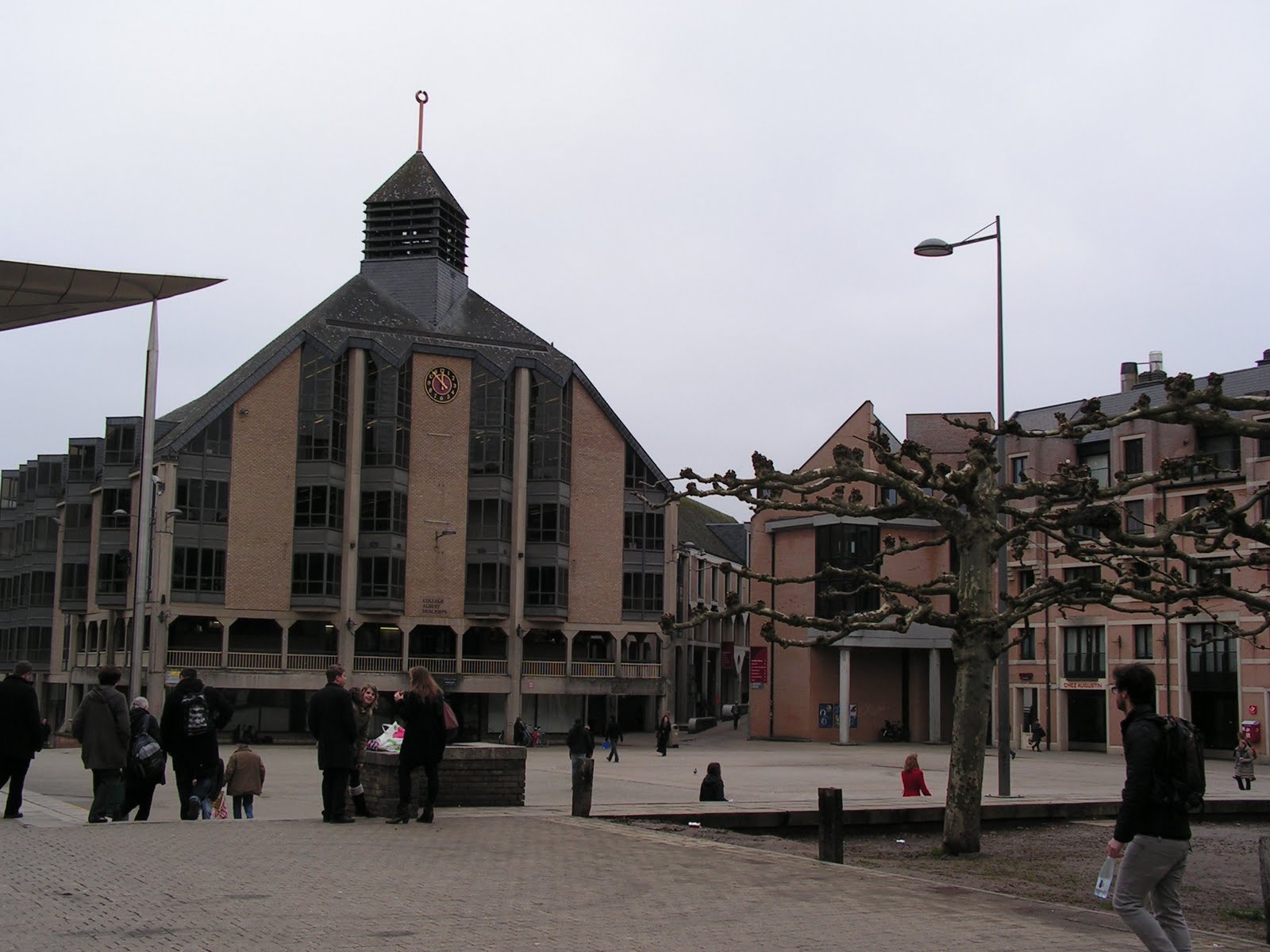
Here is the iconic picture of the Grand' Place.


When I first arrived, I lived in a dorm room in this building:
It was a large dorm where I didn't know anybody (not for lack of trying). I shared a bathroom with a woman who ignored me completely and had frequent loud parties. Here's Rue des Wallons, not far from the dorm.
Soon after, I moved across town to this place, which I shared with six Belgian students: It was much friendlier, and the building had just been built so it was clean. I learned a lot of French from living with these young women. They became my friends.

I also hung around with the other foreign students. My friend Silvia lived in this building, first window on the left, first floor (that's the second floor to Americans).
I'll say more about LLN and how it has changed in another post. Then back to stories.