Showing posts with label Belgium. Show all posts

Thursday, March 24, 2011

Art in Louvain-la-Neuve

I'm winding down my posts on the 2011 Belgian tour.

My search for pie brought me to this piece of pi, near Marie's house.

This sculpture is right by the train station, welcoming people to the city of Louvain-la-Neuve. It was, as you can see, market day.

This statue sits with its back to the indoor swimming pool.

I saw three statues in this style, but only this one had a background of "soirée cocktails." So much more refined than a keg party.

Fee-fi-fo-fum! I wonder if Jack sat in the little chair by the door.

Monday, March 21, 2011

Begin the Béguinage

In a country where it rains often, a clear day feels like a blessing.

It was still chilly, still winter coat weather, though I didn't need a hat.

This was my last Friday on the Belgian tour. I walked across town to my friend Christine's house for lunch and then we set out in her car for Leuven.

I wrote earlier about how the French and the Flemish split the Catholic University of Louvain in the 60s. The Flemish stayed in the old city of Leuven, while the French built Louvain-la-Neuve from scratch in the middle of a field. I vaguely remember going dancing with friends in Leuven as a student.

Christine wanted to show me the Grand Béguinage of Leuven. I knew the Cole Porter song Begin the Beguine, but that's completely different. I wonder what the Béguines would think about the dance of the same name, a slow rumba.

The Grand Béguinage is a historical quarter that housed the Béguines, a community of unmarried women who were not nuns but who carried out good works and lived a life of religious contemplation. This community began in the 13th century, with its height during the 17th century. The last Belgian Béguine (say that five times fast) died in 2008. The church--and men in general--had no authority over these well-organized communities of women, so clerics were nervous about them. Women did not have to renounce their property and they could leave at any time.

The Béguinage is a lovely, quiet area.

Cloistered, yet not a cloister.

Christine hates to have her picture taken, as you can tell.

The Dijle river forms two canals surrounding the Béguinage.

I love all the patterns in this picture!

Little half-chick up there was brilliant against the blue sky.

This was part of the door of the church, which was not open for visitors. Looks a bit forbidding!

There's plenty of work for an industrious brickmason here.

As you can see, everything is pristine.

I don't know what the initials in the cobblestones stood for.

There were saints' niches in many of the buildings.


This seal of the university has been used by both the French and the Flemish for hundreds of years. Christine told me that the French have begun using a different one.

The university now owns the Béguinage as part of its campus, primarily for student and visitor housing. No, there are no loud parties, no frisbees on the lawn, no sunbathing.

There are, however, plenty of bicycles.

Tuesday, March 15, 2011

A little more of Belgium

Darn this short attention span! I had all kinds of good intentions for blog posts about Belgium. Maybe this set of miscellaneous pictures will jog my memory.

This restaurant was in Louvain-la-Neuve when I lived here almost 30 years ago. Sure, you can buy crepes on the street as a sweet snack, but here you can treat yourself to a whole meal of savory filled (and filling) crepes.

Louvain-la-Neuve still has a few older farm buildings, enveloped by new buildings.

This one (above) is about two minutes from Marie's house.

Looks bucolic, doesn't it? The Ferme du Biereau, now a cultural arts center and music venue, is right next to a school, not far from the Cyclotron Research Centre, of interest to all you nuclear physicists reading this blog. I remember going to concerts there--at the farm, not at the cyclotron.

Marie and I walked from her house to pick up her veggie subscription from the CSA (community supported agriculture). We passed sheep--notice the buildings of LLN in the background.

This CSA pickup was in "La Baraque." It's a neighborhood that is an alternative to the sameness of LLN architecture, mentality and lifestyle. Many of the houses/structures are built by the residents, who live cooperatively. Here are a few of the buildings in the neighborhood:


Refreshing to see these interesting houses after the relentless brick of Louvain-la-Neuve.

Friday, February 25, 2011

Louvain-la-Neuve

Thirty years ago (yikes!) I was a student at the Université Catholique de Louvain, in Louvain-la-Neuve, for my junior year of university. That is when I first met my friend Marie, with whom I stay when I visit Belgium. I knew Marie from Russian class, but only slightly. She became my real friend two years later when we both lived in Sofia, Bulgaria. Department of Small World. We've been good friends ever since.

At any rate, today I wandered around LLN. Without going into great detail, here's a short history: in the 1960s, there were linguistic differences between the French and Flemish, so the Catholic University of Louvain split in two. The Flemish stayed in the old city of Leuven, with the Katholieke Universiteit Leuven and the French began to build a city for the Université Catholique de Louvain in the middle of some fields. It was designed as a pedestrian city, with parking garages and streets below the buildings, though now there are quite a few cars up above. More than there were 30 years ago, at any rate.

It's strange that this university, founded in 1425 and boasting such luminaries as Erasmus and Mercator, should look so modern. There's constant building, too.

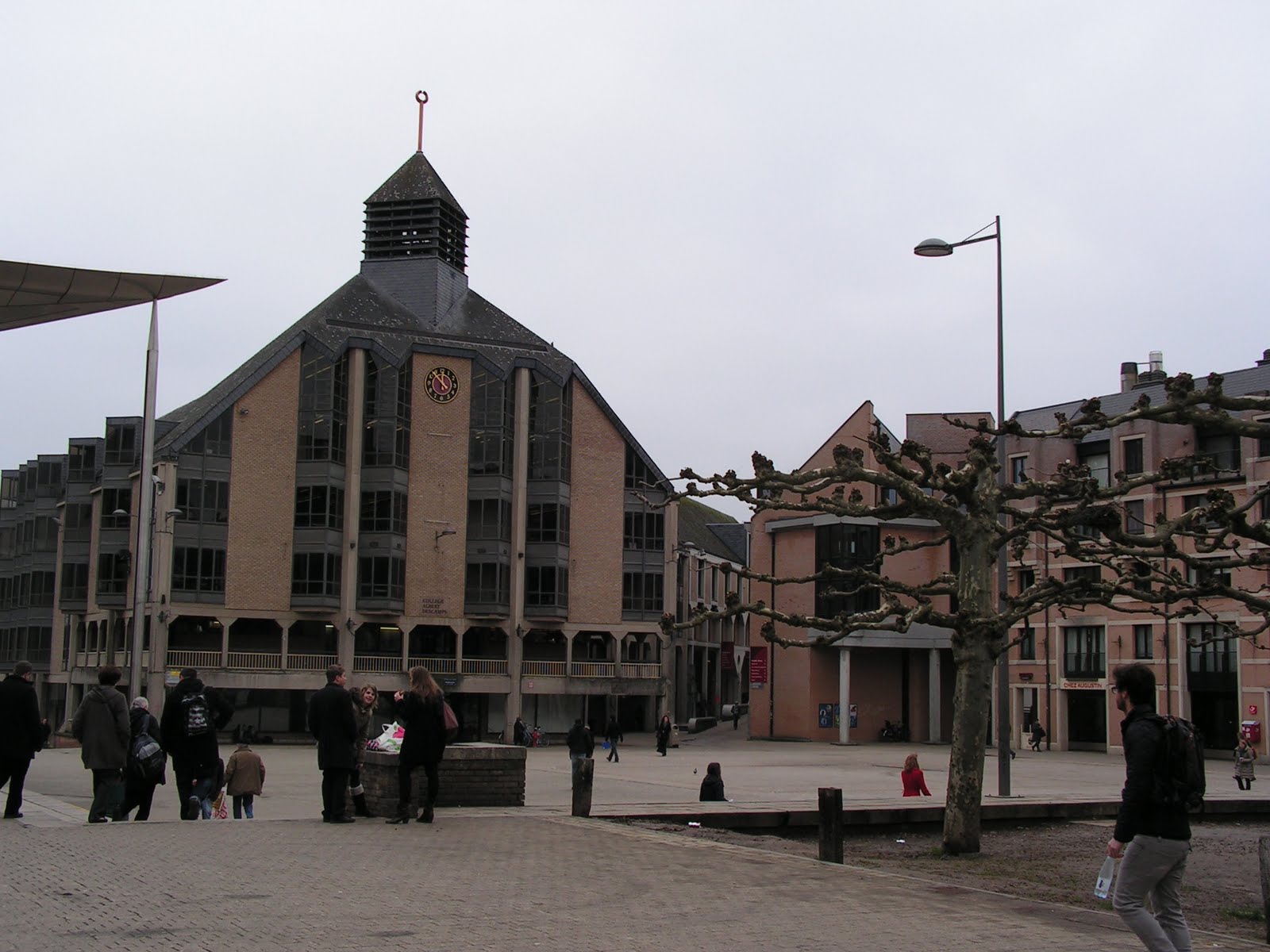
Here is the iconic picture of the Grand' Place.


When I first arrived, I lived in a dorm room in this building:
It was a large dorm where I didn't know anybody (not for lack of trying). I shared a bathroom with a woman who ignored me completely and had frequent loud parties. Here's Rue des Wallons, not far from the dorm.
Soon after, I moved across town to this place, which I shared with six Belgian students: It was much friendlier, and the building had just been built so it was clean. I learned a lot of French from living with these young women. They became my friends.

I also hung around with the other foreign students. My friend Silvia lived in this building, first window on the left, first floor (that's the second floor to Americans).
I'll say more about LLN and how it has changed in another post. Then back to stories.

Monday, February 21, 2011

Belgian Tour 2011

I'm back in Belgium, for the tour I make every two years. I arrived on Saturday. Today I was at Collège Saint-Louis in Liège. I left Louvain-la-Neuve this morning at 7:30 by train. Around 9 the train pulled in to the new Liège-Guillemins train station. Last time I was in this city, some years ago, this didn't exist! It was designed by Santiago Calatrava and is quite impressive.

I walked from the train station about 25 minutes to the school, crossing the Meuse river:
In Belgian cities, it's common to see a mixture of very old and very new architecture.

Quite near the school is the brand new Médiacité. It's a confusing name, because in fact it's a large shopping mall and entertainment center, not just for media. You can see a little bit of it between these buildings, the red and white structure that looks a bit like a bouncy house. This is where I went for lunch in between shows.
On to the school. I really enjoyed myself, both with the students and with the teachers, who welcomed me warmly.

Collège Saint-Louis has an English immersion program, in which students study for part of each day in English. I had two performances, one with the immersion students in 2nd year and one with the students in 3rd year. I think, though I'm not certain, that these are the equivalent of 7th and 8th grades in the US (12-14 year-olds). Because some English immersion schools are for younger children and because I forgot to ask who the audience would be (note to self: ask all the pertinent questions!), I took my puppets. I did what I normally do: I asked these adolescents if they'd like to meet the puppets I have for the younger kids. As usual, they said yes.

The students today were excellent listeners. With adolescents I often start with a creepy story, so the listeners understand that this is not for babies. Today I told the old English story Mr Fox (not an actual fox, but a sly man), a version of Bluebeard. Then on to other stories. I had more time with the first group, so we had a longer Q & A period at the end.

I took a couple of pictures out the window just outside the small auditorium at the school. Despite the typical gray winter weather, it's a pretty view:


Fun day. I will say, though, that I came close to falling asleep on the train on the way home, from the combination of travel and satisfying work.

Tuesday, April 14, 2009

Belgian surprise

I love Belgium, despite the rain, the mist, the drizzle, the grayness of the winter. I spent my junior year of university there and now go every two years to tell stories. I know the people, the food, the landscape. I've never seen anything like this event when I've been in Belgium--what a complete and delightful surprise:


I know it's a publicity stunt for a reality show, but I don't care. I'm planning to watch this when the gray weather here gets to me.

Friday, February 20, 2009

Queen Berta and King Pippin, yet again

I'm giving a house concert of "Queen Berta and King Pippin" tomorrow. Am I working on the story now? No. I'm simultaneously stalling and chastising myself for not working on it. This is my pattern. I know it, it happens often with large projects, and yet...

Still, I did work on "Queen Berta and King Pippin," a.k.a. "Berte aus grans pies" or "Berthe aux grands pieds," intensively while I was in Belgium. Because I didn't have performances every day, I set myself the task of translating the story into English. I began this two years ago, working from the Old French (OF). That was before I dug up the Modern French (MF) version (published in 1897, and delivered by mail from Belgium, coincidentally). I read the whole thing several times and slogged through translating about half of the OF. The last time I studied OF was 26 years ago.

I didn't need to prove to myself that I could translate the OF. What I wanted most was the story, so I worked on the translation from MF. Adenet Li Rois, the author of this Medieval work wrote it originally in verse. The MF version was in prose. Much easier. In both, there's lots of repetition, likely because the story was intended to be read aloud and that way the listeners could have a short reminder of where the reader left off in the previous session.

I did it! I finished on the Wednesday before I came home, fortunate as my friend had warned me that she wouldn't take me to the airport if I wasn't finished (my sweetie at home, when I told him this on the phone, said something along the lines of, "Ahem. I'll come get you in that case").

It was incredibly satisfying to get to the last page (165 in the book, translated to 70 in a single-spaced Word document), to chapter CXLIV.

Before I finished the translation, I told it twice in Belgium, also at Marie's kitchen table. You might remember that I told the story last year at the Going Deep Long Traditional Story Retreat, and I told it a few other times. Each telling gets a little richer.

I'm planning to run through it tomorrow morning, possibly on a walk where I can't interrupt myself to do laundry or bake bread or vacuum the living room or engage in any number of other stalling techniques.

Tuesday, February 03, 2009

Whiskey?!

Yesterday I told stories at an English immersion school in Familleureux, here in Belgium. I had four performances before lunch, under the influence of jetlag, but it went well all the same. In the second set, for the youngest children, I told Robert Munsch's story Mortimer. In this story, Mortimer doesn't want to go to sleep. Everybody in his family goes upstairs to tell him to go to sleep. After each try, they go downstairs for a nice cup of... I wait for the kids to tell me.

Yesterday, I said, "Mortimer's father sat down in the living room with a nice cup of..."

One of the teachers called out, "whiskey!"

Some days, it's hard to compose myself after a moment like that, but I did. I laughed about it with her afterwards.

On a serious note, this would never, ever, ever happen in the US. Occasionally a kid will suggest beer or wine, but a teacher would never suggest whiskey. Is it just because we live in politically correct times, or is it the long streak of puritanism?