Friday, July 22, 2011

A headful of stories and a bagful of puppets

I was asked to be a guest blogger on the Novel Adventurers blog, so this is cross-posted there. I decided to write about a performance in Peru.

I highly recommend visiting Novel Adventurers. Great reading and lots of armchair travel.

(By the way, the first picture isn't the one on that blog post. On this one, Blogger decided that picture looked better on its side, no matter what I did. Fie.)

Slow down, I remind myself. I look at the audience in front of me, this time third and fourth graders (eight- and nine-year-olds) in school uniforms. They’ve settled in, sitting in rows, wondering what I’m going to do. I pied-pipered them into the hall with my harmonica. I try to engage them as quickly as possible so we can get down to business.

That is, the business of stories. I’m a full-time storyteller, and this audience is in Peru, made up mostly of kids who are learning English as a second language. At this school, a few are native English speakers. I pull out my map of the United States. This is not just a geography lesson, but a way for the students to get used to my voice and accent before I begin the stories. I show them Kansas, where I live. “But I was born over here in Rhode Island. My mother lives in Maine. My brother lives in Oregon. My sister lives in Kansas. My sister lives in Wisconsin. My brother lives in Kansas.” By this time, the kids are laughing. “My brother lives in Vermont. And my sister lives in Massachusetts. I have three brothers and three sisters.


We’re almost ready for the stories. “I brought a friend with me, in my bag. Do you travel with your friends in a bag?” I reach in and pull out my old lady puppet, Trixie. “Una bruja!” I hear. I answer in English, “She does look like a witch, you’re right, but she’s not. She’s just old. She’s 111 years old.” Trixie introduces herself and she and I discuss which stories to tell. “Can we have a story about hair?” she asks. “Hair?!” It becomes clear that she wants either Rapunzel or Robert Munsch’s story, Stephanie’s Ponytail, (I have his permission to tell this). I sit Trixie on the chair gently, with her head in her lap. She may well fall asleep.

We’re off. I tell stories for about 45 minutes, with puppets and songs in between. My baby puppet is always a big hit—she could pop her pacifier out of her mouth twenty times and get a laugh each time. In this show, she only does it seven times. With middle school and high school students, I tell more sophisticated stories with fewer or no puppets. With this audience, I do a short Q and A at the end. They ask about stories, about puppets, about me.
Photo by Annie Tichenor

Here are some of the questions they ask:

Q. Where do you get your stories?
A. Many are folktales, which I find in books or I hear from other storytellers. Some are from books, and some are my own stories.

Q. How long have you been a storyteller?
A. I’ve been telling stories since 1988. I told stories in my job as a children’s librarian for five years and then in 1993, I left my job to become a full-time storyteller.

Q. What’s your favorite story?
A. That’s a good question. The big rule in storytelling is, only tell stories you love. So I love all my stories. My favorite is the one I’m telling at that moment. The favorite story of listeners is usually The Ghost with the One Black Eye.

Q. What countries have you visited to tell stories?
A. I’ve performed around the United States and in Belgium, Mexico, Bulgaria, Germany, Brazil, and Peru.

Q. Do you have any more puppets?
A. I have more at home. I have around 75 puppets in all. In my house I have a puppet room, where they all live.

Q. Do you like telling stories?
A. I love it. I’m lucky that I get to work at something I love.

Saturday, July 16, 2011

Peru miscellany

I've got leftovers in my photo album. They don't need a whole blog post, just a line or two.

In Trujillo we stopped at the botanical garden near the school. Can you see what this is?

I'd never seen a poinsettia that big!


I don't know what this next one is. Maybe I should have left a bowl of food out for it.


And here's a built-in star at the top of the Christmas tree:


These two door knockers were in Trujillo:


And on another completely unrelated note, turtles at the botanical garden in Trujillo:


One day I saw a couple of interesting cars in Miraflores near my apartment:


In various places there were quiet tributes to the Nazca Lines, geoglyphs in the south of Peru. I never got to Nazca, but I did get these pictures in the park overlooking the ocean:


And for no particular reason, I'll end with this little bird:


Trujillo archaeological sites

It has been a month since I came home from Peru, so I'd better hurry up and finish the last posts about the tour.

Back to Trujillo. On Thursday, I did four performances at the school. At that point, the count was 78 shows, with two more to go. My energy was flagging. After the performances,Gustavo and I went to the restaurant where we had the fantastic ceviche and causas, which revived us considerably. From there we caught a bus to Chan Chan, amazing Pre-Columbian ruins not far from Huanchaco Beach. They were inhabited by the Chimu people, from about 850 AD to 1470 AD, when the Incas conquered them.

It's a huge fortress. I heard that the only way the Incas defeated them was by starving them out. The structures blend into the sandy coast, adobe with figures carved into them (or made with molds). Much of the site, like Machu Picchu, is reconstructed.

Here's the plaza just inside the entrance:
The two figures were the only pieces that wasn't sand-colored. The art is representational, with lots of birds, fish, crabs, etc., in geometric patterns.


I loved the shapes of the adobe structures.


Parts of Chan Chan are covered with roofs now. Erosion is a major issue, as you can imagine.


The next day, after the last two shows (my gosh, is it really over? did I do eighty shows in five weeks? am I still alive?), we went to the Huaca de la Luna, the Temple of the Moon. This is on the other side of Trujillo, and was built by the Moche people, from 100 to 800 AD. It's unclear what happened to the Moche. Our guide told us they may have moved because of climate changes or because of an epidemic, but they were not conquered by invaders. They just sort of left.

The structure is brick, but not rounded like Chan Chan. It backs up to Cerro Blanco, or White Hill.
The Huaca is a pyramid, with several layers. Across the valley is the Huaca del Sol, which was looted by the conquistadores. That temple isn't open to the public. I didn't get good pictures of the Huaca we actually visited, but it was similar in shape.

There were amazing mosaics inside the layers. This is close to the top.
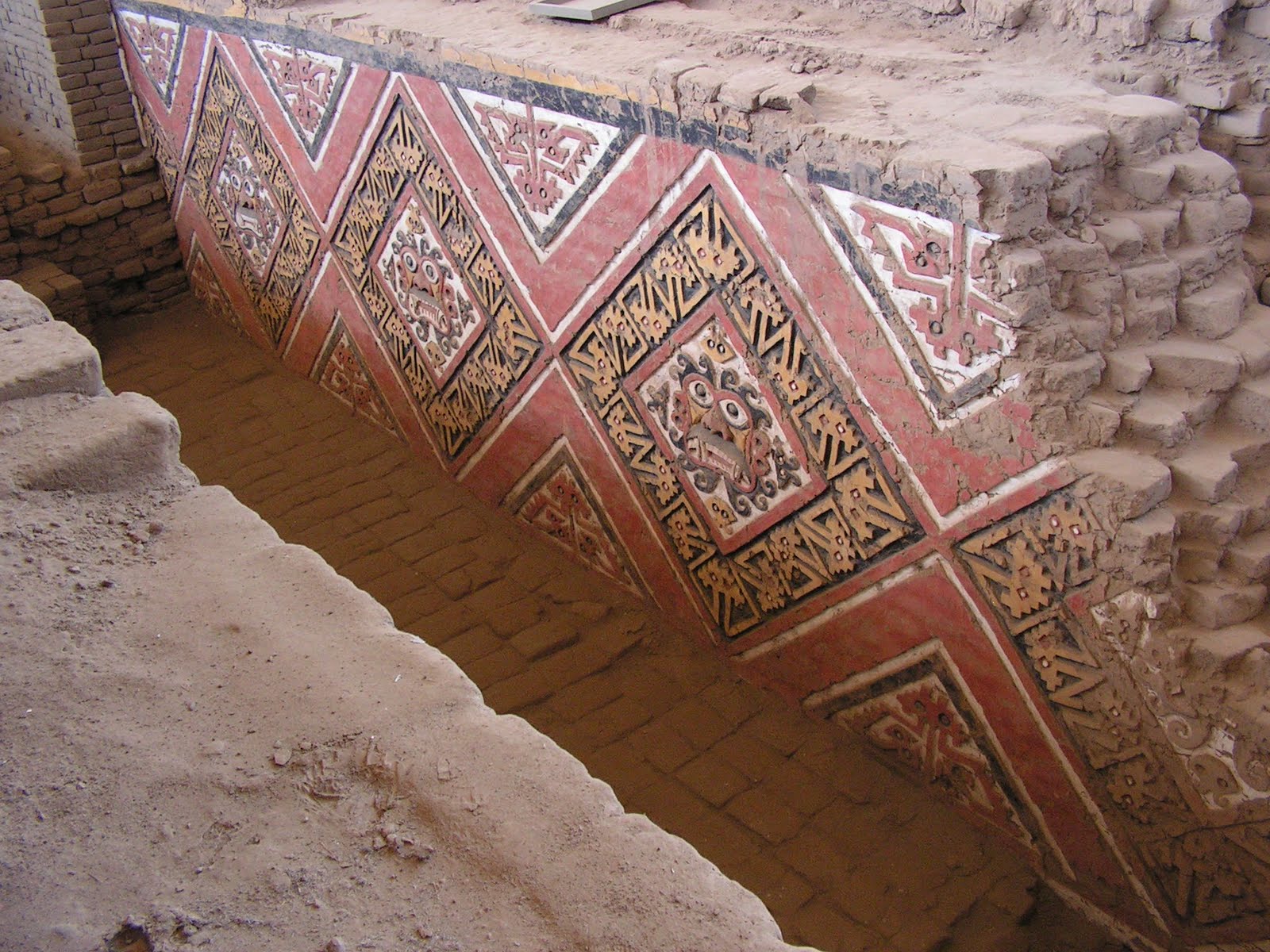

And a close-up:


You can see the layers better from this side:

See the blue cat?

Here it is closer:

And even closer:

There were workers here, as there were at Chan Chan. Who knows how much of the ruins are reconstructed. I only hope they're done with an eye to historical accuracy.


After this, we went for a quick tour around downtown Trujillo (lunch of cabrito, as goat is a specialty of the region), then went back to the beach, where we put our feet in the water. We walked down the pier to watch people fishing, went into the fish museum (not an aquarium, but a museum of stuffed and mounted fish), then went back to the hotel for much deserved naps before meeting up again for a final light supper and a farewell pisco sour at Sabes. The day wasn't quite done--the taxi picked us up at the hotel to take us to the bus station for the 10-hour ride back to Lima. I slept almost all the way.

Saturday, July 09, 2011

Food pictures from Peru

I've never understood people who don't care about food. I'm not a foodie--I don't have to have the latest fad or the most expensive. I just like food. I like eating it, cooking it, talking about it. It's an added bonus when it's also pretty. Here are a few pictures of the fancier meals I had in Peru, those that were also a feast for the eyes.

I know I already posted this picture of the picante de quinoa I had in Aguas Calientes. That's a tomato in the shape of a rose in the middle.


We went to eat at the Huaca Pucllana in Miraflores, the part of Lima where I lived the evening after the sea lion trip. By the time we went, we'd all had long naps and felt better (if sunburned). These were the appetizers:

Those are giant shrimps, I think. In the background you can see the causas, which in this case are little cups of mashed potato filled with crabmeat. There's a better picture of causas later.

This was my main dish, an Amazonian fish on a bed of potato, topped with fried banana. Very tasty.

It wasn't until the last week, when we were in Trujillo, that I remembered to get a picture of ceviche, raw fish, which gets sort of cooked by lime juice, with red onion, red pepper and cilantro. I'm not sure what else was in this one. It was probably the best ceviche I had on the trip--I must have had it ten times at least. And to think that I didn't think I'd like it. Also in this picture is a different shape of causa, like a giant potato oreo. On the plate next to the ceviche is a sweet potato and giant corn kernels.

Back in Lima, my very last day was also Gustavo's birthday. Time for a celebration! Gustavo, his sweetie, his son and I had a birthday and farewell lunch at his favorite restaurant. We began with causas, which were filled with crabmeat in one, tuna in the next and chicken salad in the third, garnished with hardboiled egg, chive, avocado and tomato. Delicious!


This last picture doesn't look appetizing, I know. It was absolutely wonderful aji de gallina, a creamy chicken dish with just the right amount of spice, sprinkled with cheese, next to a serving of rice. The rice often comes in a kind of cake. Gustavo often brought along olive oil to pour over his rice.


Now that I've written this, I realize I'm hungry!